Design Thinking Workshop
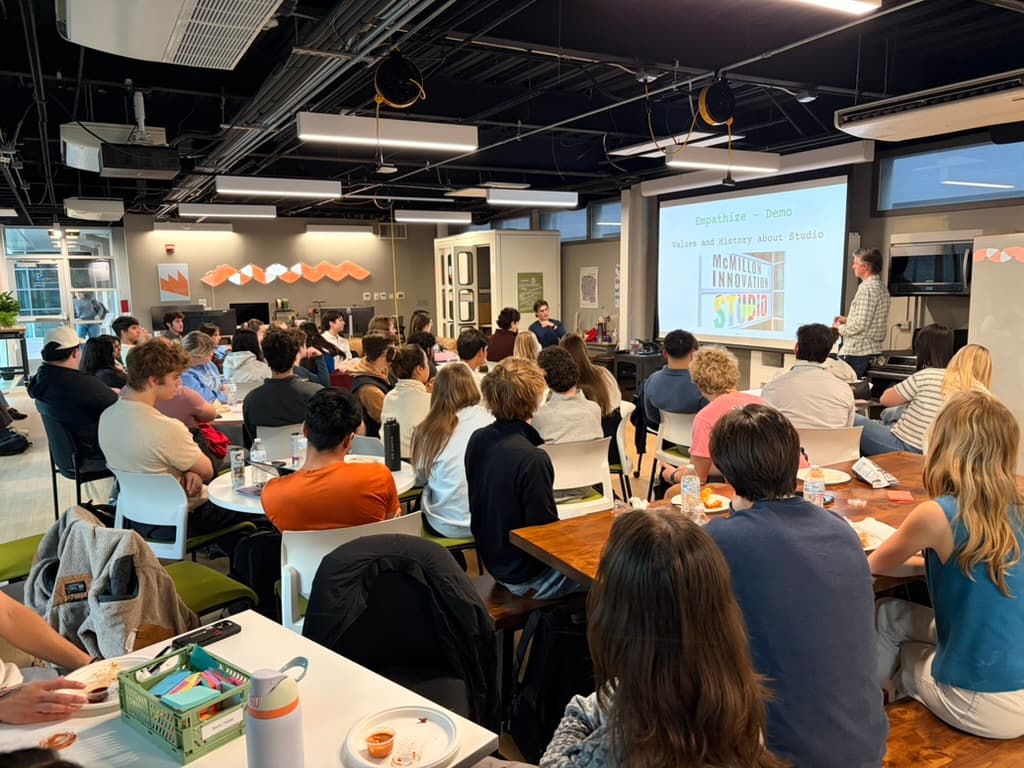
Designed and facilitated a 90-minute design thinking workshop for 70+ students at McMillon Innovation Studio
Overview
Goal
Through conversations with McMillon Innovation Studio members, I identified two gaps in the orientation experience:
-
Design Thinking Education Gap: Students joined teams and started working on projects immediately, learning design thinking "as they go" through team leaders. They never had a dedicated time to understand what design thinking is, how to apply it, and what the semester-long process would look like.
-
Engagement Gap: Past orientations were static and used overly specific, domain-heavy problem statements. The activities felt more like assignments than exploration. I wanted to make it as engaging, fun, and relatable as possible—giving students a challenge they could get creative with in 2 hours.
Event Details
- Date: February 12, 2026
- Time: 5:00 PM – 7:00 PM (90 minutes total: ~15 min orientation logistics, 60–75 min Design Thinking workshop)
- Audience: McMillon Innovation Studio students (Design Team), studio director, and graduate assistants
- Attendance: ~70 students (prepared for 60, had 5+ standing)
Outcomes
The workshop achieved both goals:
- Students understood what was coming: New members said they now had a clear picture of the semester ahead and how design thinking would be applied at the studio.
- Highly engaging: Students said the challenge was relatable and fun. Multiple people came up afterward to share positive feedback unprompted.
- Energy spillover: The Product Team (running their orientation upstairs) felt FOMO from the music and excited conversation happening downstairs. Two product team members came down just to see what was going on.
- Music mattered: Students liked the playlist (borrowed from the school's playlist—sometimes the small details land).
Compared to past orientations, feedback emphasized that this one was more engaging, more fun, and more relatable.
Planning
Understanding the Problem: Student Feedback from Past Orientations
I interviewed students who attended previous McMillon Innovation Studio orientations to understand what worked and what didn't. The feedback revealed several recurring issues:
- Lack of clarity: Students had no idea what the orientation would entail. Many skipped it entirely because they didn't know what was coming or whether they needed to attend.
- Same content every semester: Returning studio members and project managers had seen the same orientation multiple times. Some stopped attending because it felt repetitive.
- Low context, high specificity: The business challenges used were the actual semester project topics. Students were asked to work on problems they had zero context for, which made the activities feel forced rather than exploratory.
- Too much listening, not enough doing: The format was heavily lecture-based—students sitting and listening, rather than actively engaging with design thinking.
- Limited networking opportunities: Students wished they had more chances to get to know fellow McMillon Studio members from other teams, especially since they'd be working in separate project teams throughout the semester.
Designing the Solution: Goals and Format
Based on this feedback, I set three design goals:
-
Maximize action, minimize lecture: Students should learn design thinking by doing it, not just hearing about it. The workshop needed to be hands-on from the start.
-
Use a relatable challenge: Instead of asking students to work on unfamiliar semester projects, I chose a problem they already had context for—something relevant, fun, and creative that would let them focus on the process rather than scrambling for domain knowledge.
-
Make it worth attending (even for returning members): The workshop needed to be engaging and different enough that even project managers and returning studio members would want to come back. It couldn't just be "orientation"—it had to be an event.
Building Cross-Team Connections
To address the networking gap, I designed the workshop to facilitate connections between students from different teams:
- The first 15 minutes were dedicated to informal networking over food and socializing
- Students were intentionally seated with members from teams other than their own semester project teams
- This created opportunities for cross-pollination of ideas and built relationships across the studio community
The Business Challenge: A Critical Design Decision
One of the most important decisions I made was choosing the right business challenge for the workshop.
In past orientations:
- The activity portion was shorter
- The business challenges were tied to students' actual semester projects
- These challenges were industry-specific, domain-heavy problems
- Students had no context or background information
- They couldn't relate to the problems and couldn't contribute meaningfully
For this workshop, I chose a real challenge that students already had context for:
"How might we bring more undergraduate students from different majors to McMillon Innovation Studio?"
I showed them the current demographics: mostly business students, some engineering, but no architecture, art, agriculture, etc.
The students in the room were the subject matter experts:
- They all went through the studio selection process
- They knew why they came to the studio and how they felt about it
- They knew what almost made them not come
- They had context, experience, and opinions
This design choice accomplished two things:
- Students could focus on the design thinking process rather than scrambling to understand an unfamiliar problem domain
- The activity felt relevant and engaging rather than forced or theoretical
As the student feedback later confirmed, this was one of the key factors that set this orientation apart from past ones.
Workshop Structure
I designed the 90-minute session in two parts:
-
Introduction (10–15 minutes): Studio overview + design thinking theory
- Instead of a static lecture, I structured this as an interview with Chris (studio director) and Dylan (another GA). This kept the theory portion engaging and conversational rather than one-directional.
- Covered the design thinking process (Empathize → Define → Ideate → Prototype → Test) and the double diamond framework (divergent/convergent thinking).
-
Workshop (60–75 minutes): Hands-on design thinking exercise
- Students worked through the full design thinking process on a relatable challenge.
- Action followed theory immediately—no gap between "here's what design thinking is" and "now do it."
Key Teaching Points (from slides)
On the Design Thinking Process:
- Empathize: Set aside assumptions. Observe users in the wild, pull deep insights from conversations.
- Define: Make sense of the mess. Synthesize walls of data to find the root cause. Describe it in one concise problem statement.
- Ideate: Generate solutions.
- Prototype: Don't think full-fledged software. It can be a role play, scrappy hand sketch, or wireframes on Figma. Make ideas tangible so you can feel and test them.
- Test: Learn and iterate.
On the Messy Reality: "This process looks linear but it's not. You'll Prototype something, Test it, realize you were wrong, and have to jump all the way back to Empathize. Design Thinking is not a straight line; it's a loop. Going backward doesn't mean you're failing. You're just learning."
On the Double Diamond:
- Pink diamond (divergent → convergent): Finding the right problem. Doing the right thing.
- Blue diamond (divergent → convergent): Finding the right solution. Doing the thing right.
Minute-by-Minute Timeline
| Time | Phase | Duration | |------|-------|----------| | 5:00-5:15 | Food & Arrival | 15 min | | 5:15-5:18 | Meet the Team | 3 min | | 5:18-5:28 | Form Groups & Intro | 10 min | | 5:28-5:43 | Intro to Design Thinking | 15 min | | 5:43-5:46 | Introduce Challenge | 3 min | | 5:46-5:56 | Empathize - Interviews Demo | 10 min | | 5:56-6:08 | Empathize - Interviews | 12 min | | 6:08-6:15 | Ideate (Silent Writing) | 7 min (5 min ideate + 2 min) | | 6:15-6:20 | Define - Converge on Idea | 5 min (pick 3 → 1 idea) | | 6:20-6:30 | Define 2 - Mini PRD | 10 min | | 6:30-6:40 | Share Ideas | 10 min | | 6:40-6:43 | Logistics | 3 min | | 6:45-7:00 | Buffer/Questions/Photos | 10 min |
Materials
- Slides: Full presentation deck (see
studio-team-orientation-spring26.pdf) - Music: Playlist borrowed from the school's collection (students loved it)
- Seating: Chairs for 60 (ended up with 70+ attendees, so 5+ people standing)
- Food: Provided during arrival (5:00–5:15 PM) to encourage early arrival and informal socializing
Execution
The workshop ran as planned. Below is visual documentation of each phase.
Making the Lecture Engaging: Interview Demo
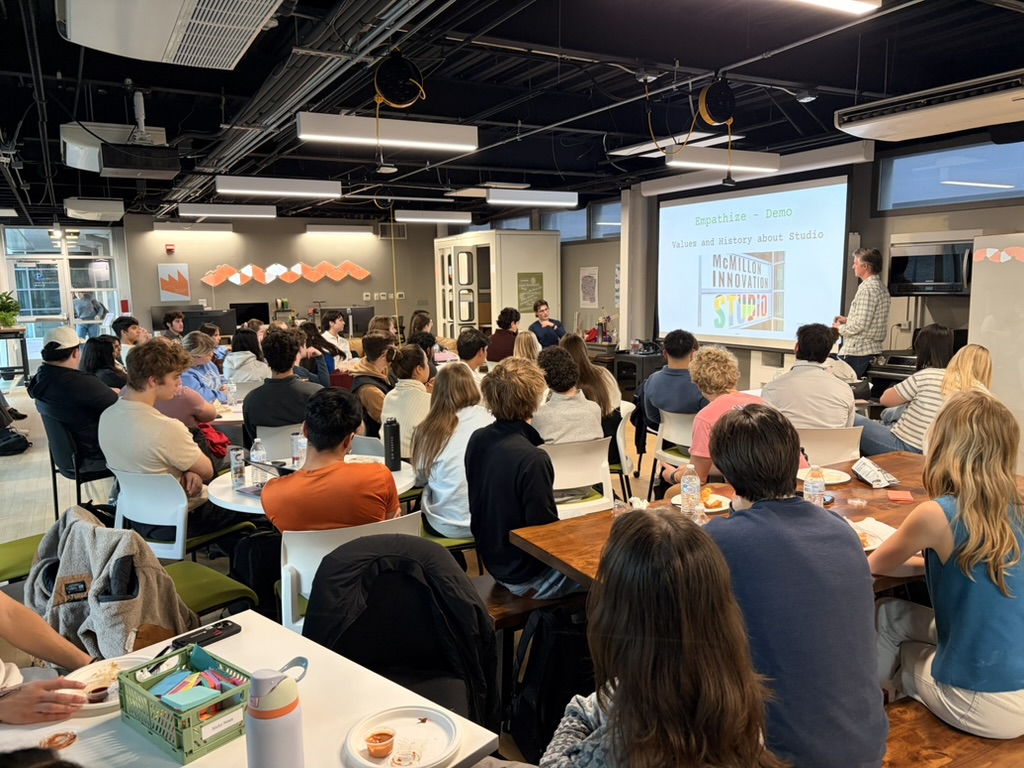 Interviewing Chris (studio director) and Dylan (GA) to make the lecture portion engaging—not just students sitting and listening.
Empathize Phase: Student Interviews
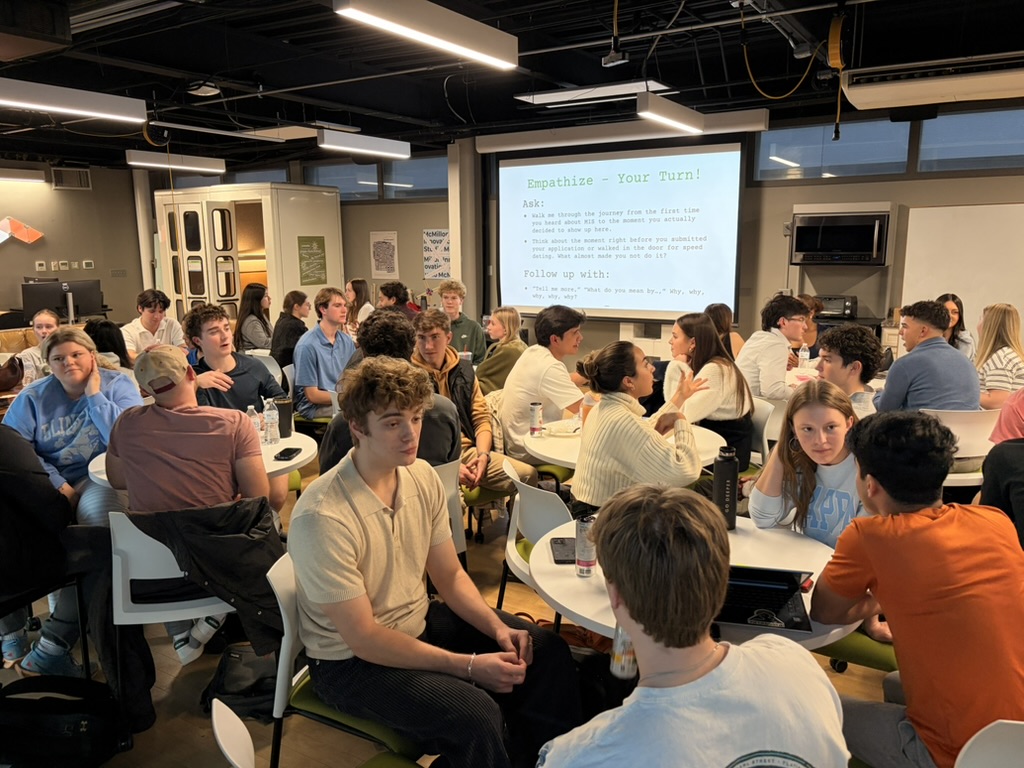 Students conducting user interviews during the Empathize phase.
Ideate Phase: Brainstorming
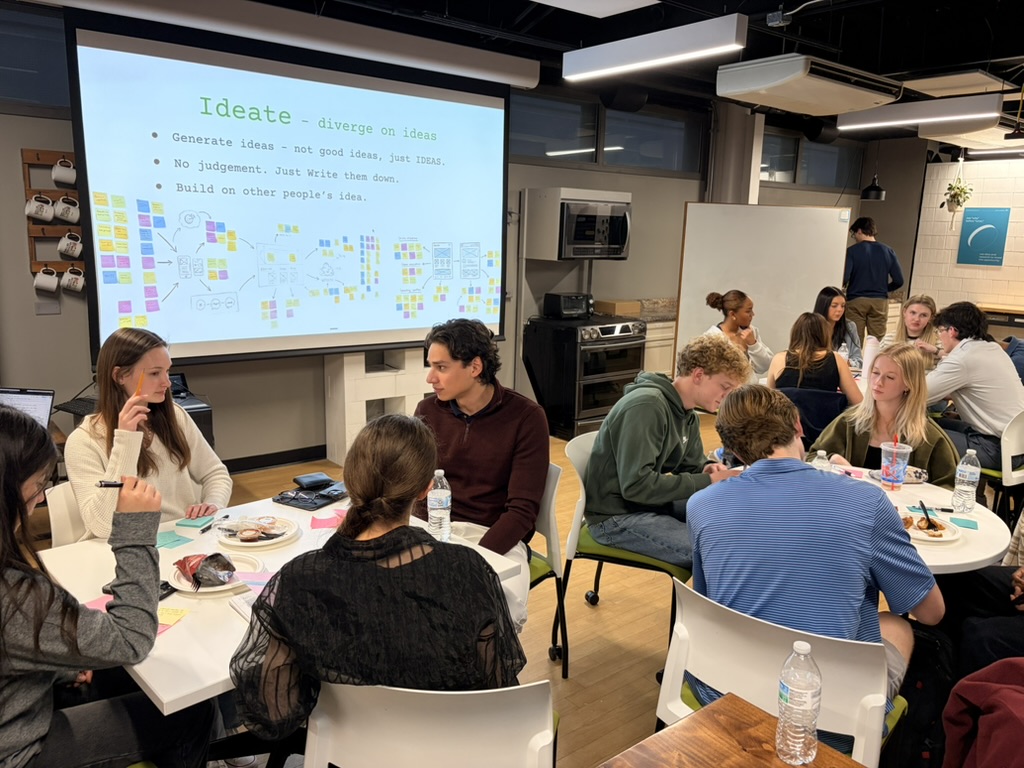 Students brainstorming ideas based on insights from their interviews.
Define Phase: Solutioning
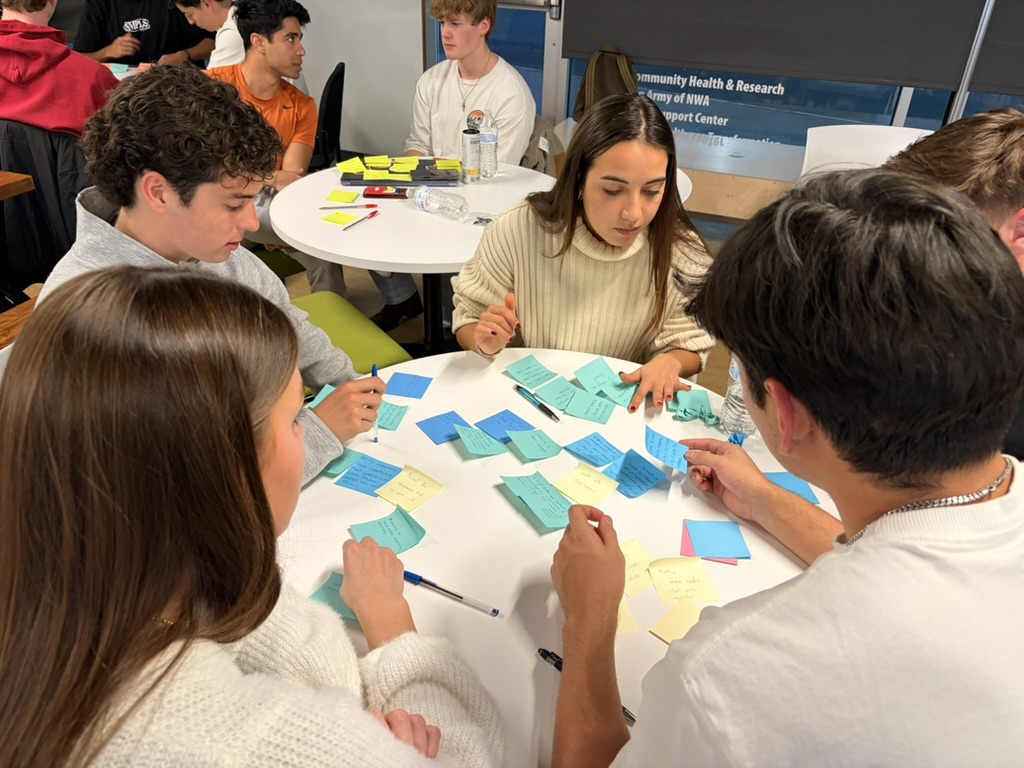
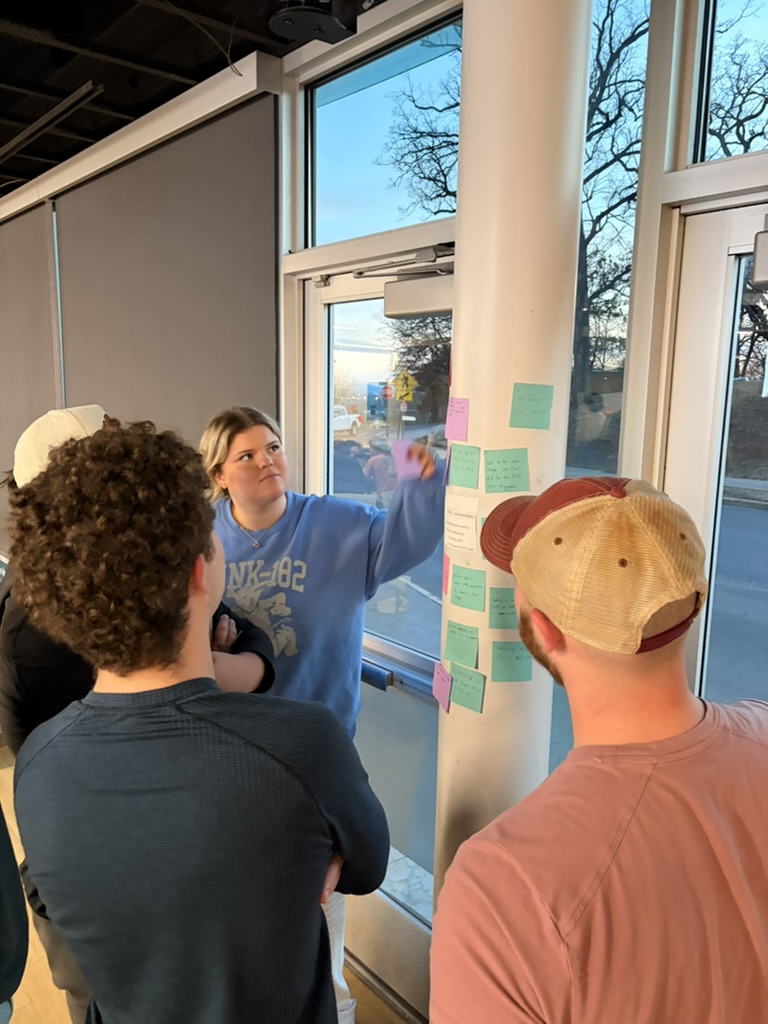 Students organizing their thoughts and converging on solutions.
Share Phase: Pitching Ideas
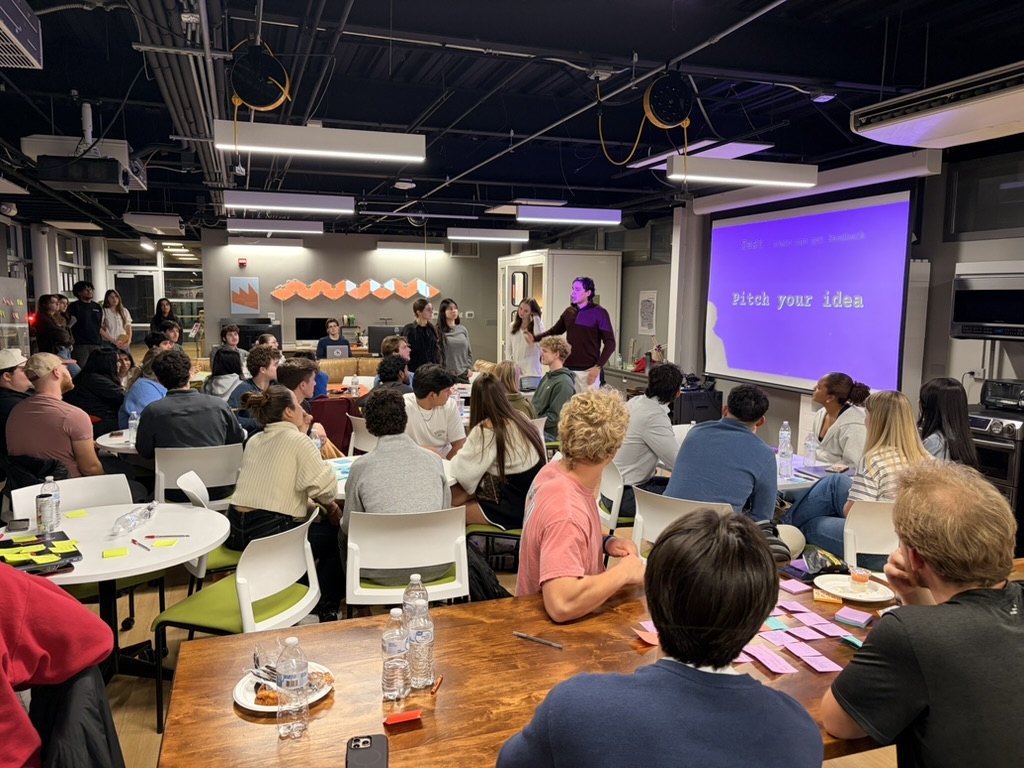 Student pitching their team's solution to the group.
Music Playlist
The playlist that students loved (and caused FOMO upstairs): Studio Orientation Playlist
Note: No one took a picture of me facilitating and leading the workshop. But I did it. Believe me.
Reflection
What Went Well: Facilitation Strengths
-
Time management: I wrapped up the intro portion earlier than planned and got ahead of schedule. This gave me breathing room to spend more time on the activity portion without rushing. Having a conservative minute-by-minute timeline was key—it gave me flexibility to adjust on the fly.
-
Music and vibe: Playing music while students worked kept the energy going. It wasn't silent and awkward; it felt like an event.
-
Balance: I found a good balance between checking on teams, engaging with them, and not hovering or talking too much. I let them work.
-
Clear transitions: I made sure to clearly state where we are and what we were doing next at each phase. This kept everyone on the same page and prevented people from getting lost.
Student Feedback
The feedback reinforced what worked:
- The relatable challenge was the key differentiator: Students said the challenge was fun and engaging specifically because they had context and could actually contribute. This validated the design decision to move away from industry-specific problems.
- Cross-team networking succeeded: Students appreciated getting to know members from other teams. The intentional seating arrangement and dedicated networking time created connections they wouldn't have made otherwise.
- They appreciated the music and the energy in the room.
- New members said they felt prepared for the semester ahead.
- Even returning members and project managers said it was worth attending—different from past orientations.
One surprise: students came up with genuinely good solutions to the studio's diversity problem that I hadn't thought of. In 90 minutes, they produced ideas worth considering for implementation.
What Could Be Improved
-
More audience engagement in the lecture portion: I was ahead of schedule after the intro. I could have asked the audience more questions during the design thinking education piece to make it even more interactive.
-
Clearer instructions: While most students understood what to do, a few didn't seem to catch the instructions (or didn't listen). I could have emphasized key points more or repeated critical instructions to make sure no one was left behind.
What I Learned as a Facilitator
This workshop reinforced a few lessons about facilitation:
-
Plan conservatively, execute optimistically: Build buffer time into the schedule. It gives you room to slow down or speed up as needed. When executing, don't obsess over the clock—focus on the flow.
-
Preparation is the most important thing: The minute-by-minute timeline, the relatable challenge, the interview format for the lecture—all of this came from preparation. The more you plan upfront, the more you can adapt in the moment.
-
Make people feel like they accomplished something: I wanted students to walk out feeling like they did a lot in 90 minutes. They did. That sense of progress came from pacing and structure.
-
Clear phases and transitions matter: When moving to the next phase, make sure everyone knows what's coming. State it clearly. Repeat if necessary. No one should be left wondering what to do next.
-
Time management is key, but engagement is the goal: Staying on time is important, but not at the expense of energy and involvement. The workshop worked because students were engaged, not because I hit every time marker perfectly.
Final Thought
Facilitating for 70+ people was a challenge, but it worked. The students showed up, participated, and left with something valuable. The energy in the room—the music, the conversations, the pitches—made it feel less like an orientation and more like an experience.
And that was the point.
Related Articles